
The Paradigm Shift in Sustainable Cosmetic Manufacturing
The global color cosmetics landscape is undergoing its most profound structural transformation in decades. Sourcing directors, product developers, and brand executives no longer view sustainability as a marketing gimmick or an optional niche line. Today, Sustainable Cosmetic Manufacturing represents a core operational baseline demanded by regulatory bodies worldwide—including the EU Eco-Design Regulation, EU Green Claims Directive, and US MoCRA standards—as well as highly informed Gen Z and Millennial consumers.
For international procurement teams searching for contract manufacturing partners, the challenge lies in finding an OEM/ODM beauty facility capable of delivering uncompromised high-performance makeup—vibrant color payoff, 24-hour long-wear capability, weightless textures, and shelf stability—while strictly adhering to green chemistry, microplastic-free compliance, upcycled ingredient sourcing, and low-carbon production protocols.
Headquartered in Inzago (Milan), Italy, MPLUS COSMETICS SRL has spent over 22 years mastering the delicate synergy between artistic Italian craftsmanship, rigorous chemical engineering, and environmental stewardship. This comprehensive B2B sourcing guide breaks down how modern cosmetic brands can successfully navigate sustainable formula architecture, packaging decarbonization, supply chain traceability, and contract manufacturing execution.
SEO Search Intent Insight for Beauty Sourcing Directors: Modern AI search engines and B2B buyers query detailed metrics: "How to ensure zero microplastics in mascara formulas without sacrificing volume?", "What are the carbon-neutral manufacturing standards in Italian cosmetics labs?", and "How to convert traditional private label lipstick to refillable mono-materials?" Below, we address every strategic layer of sustainable color cosmetics production.
Strategic Pillars of Green Chemistry in Private Label Cosmetics
Traditional color cosmetic formulations rely heavily on synthetic silicones (such as D4, D5, D6 siloxanes), petroleum-derived mineral oils, synthetic film formers, non-biodegradable microplastic glitters (PMMA, PET), and per- and polyfluoroalkyl substances (PFAS). Sustainable cosmetic manufacturing systematically replaces these legacy ingredients with high-performing, renewable bio-alternatives.
1. Microplastic-Free & Bio-Based Film Formers
In product categories like mascara, liquid eyeliner, and long-lasting foundations, film-forming polymers provide transfer resistance, smudge-proofing, and water resistance. MPlus Cosmetics R&D team has engineered natural film-forming matrices utilizing sugar cane derivatives, pullulan, starch octenylsuccinates, and natural rosin resins. These bio-polymers deliver identical structural flexibility and hold on lashes and skin without depositing persistent microplastics into aquatic ecosystems during wash-off.
2. Upcycled Botanical Actives & Circular Ingredients
Circular economy principles are fundamental to MPlus's raw material sourcing framework. By utilizing upcycled cold-pressed seed oils (derived from wine pomace, berry seed waste, and olive oil byproduct streams), our laboratories formulate skincare-infused makeup products that provide antioxidant nourishment while actively reducing agricultural waste footprints.
3. ECHA-Compliant Mineral Pigments & Ethical Mica
Color fidelity is non-negotiable. Our sustainable pigment architecture utilizes high-purity surface-treated iron oxides, ethically sourced natural micas certified under strict fair-labor audit standards (Responsible Mica Initiative), and synthetic fluorphlogopite as a eco-friendly substrate alternative for shimmering textures.
Featured Eco-Conscious Product Solutions
MPlus Cosmetics offers end-to-end custom OEM formulation and private label solutions across all main color cosmetic categories. Each category is engineered to balance clean beauty standards with luxury sensory appeal.

Sustainable Primers, Bio-Foundations & Hybrid Concealers
Modern consumers demand face makeup that acts as an extension of their skincare routine. Our eco-friendly face range eliminates volatile D5 silicones and cyclic siloxanes, replacing them with plant-derived alkanes, bio-engineered squalane, and natural lecithin emulsifiers.
- Silicone-Free Mattifying Primers: Utilizing natural bamboo silica micro-spheres to blur pores and absorb sebum.
- Skin-Nourishing Bio-Foundations: Breathable, buildable liquid foundations enriched with upcycled flower waxes and organic hyaluronate.
- Zero-Waste Cream Concealers: Highly pigmented, non-creasing formulas packaged in recyclable mono-material aluminum pans.

Eco Mascaras, Microplastic-Free Eyeshadows & Bio-Wands
As a global authority in mascara manufacturing, MPlus combines clean bulk formulas with patented applicator engineering. Our eye makeup formulas pass strict ophthalmological testing while ensuring top-tier volumizing and lengthening metrics.
- Clean Volumizing Mascara Bulks: Formulated with organic carnauba wax, berry wax, and natural bio-cellulose fibers for buildable lash thickness.
- Biodegradable Glitter & Eyeshadows: Plastic-free metallic and shimmer eyeshadows utilizing plant-derived cellulose glitters.
- Bio-Based & PCR Mascara Brushes: Custom molded wands crafted from bio-injected castor oil polymers or recycled plastic resins.


Refillable Lipsticks, Bio-Glosses & Organic Lip Oils
Lip formulations demand deep hydration, non-sticky slip, and rich color pay-off. MPlus delivers full-turnkey lip production utilizing 100% natural-origin ester bases and refillable luxury packaging.
- Refillable Bullet Lipsticks: Custom matte, satin, and sheer bullets housed in reusable aluminum or PCR cases.
- Clean Lip Gloss & Oils: Non-petroleum glosses powered by upcycled botanical lipids and natural hyaluronic spheres.
- Vegan Lip Liners: Precise, high-glide lip pencils formulated without microcrystalline wax or synthetic paraffin.
2025–2030 Procurement Trends in Sustainable Beauty Manufacturing
Beauty procurement managers must anticipate regulatory hurdles and technological advancements when selecting an OEM partner. Here are four defining trends shaping the future of contract manufacturing over the next five years:
Trend 1: Decarbonization & Scope 1-3 Carbon Footprint Auditing
Leading beauty conglomerates are requiring contract manufacturers to provide validated Life Cycle Assessments (LCA) per stock keeping unit (SKU). MPlus Cosmetics operates out of a modernized green facility in Milan, utilizing energy-efficient manufacturing vessels, closed-loop water filtration systems, and solar energy installations to minimize Scope 1 and Scope 2 operational emissions.
Trend 2: Mono-Material & Refillable Packaging Compatibility
A major cause of packaging failure in sustainable cosmetics is formula-pack incompatibility. Volatile ingredients or natural oil bases can cause stress-cracking or degradation in Post-Consumer Recycled (PCR) plastics or bio-resins. At MPlus, our in-house stability and packaging compatibility testing protocols verify that every clean formula operates seamlessly inside refillable aluminum tubes, glass bottles, and PET mono-material compacts prior to mass production.
| Packaging Material | Recyclability Rating | Formula Compatibility | MPlus OEM Solution |
|---|---|---|---|
| 100% Aluminum | Infinite / Highest | High (with protective lacquer) | Refillable Bullet Lipsticks & Aluminum Tubes |
| Mono-Material PET / PP | 100% Recyclable | Optimal for anhydrous & emulsion bulks | Mascara tubes, compacts & concealer wands |
| Bio-Based Polymers (Castor/Sugarcane) | Compostable / Bio-sourced | Tested for water-based emulsions | Custom Mascara Applicator wands |
| Glass Containers | 100% Circular | Excellent barrier protection | Foundation & Primer pump bottles |
Trend 3: Strict Adherence to Global Clean Beauty Standards
Navigating global blacklists—such as Sephora Clean, Ulta Conscious Beauty, Credo Clean Standard, and EU Cosmetics Regulation (EC) No 1223/2009—requires deep regulatory intelligence. MPlus maintains a real-time global compliance database, ensuring all private label formulations automatically exclude over 2,000 toxic or environmentally controversial chemicals.
Trend 4: Accelerated Time-to-Market via Modular Formula Architecture
Developing a custom organic formula from scratch can historically take 12 to 18 months. To solve this bottleneck, MPlus has developed a library of pre-tested, stability-proven base formulations ("Modular Green Architecture"). Brands can customize shade ranges, natural fragrances, and hero botanical actives, slashing R&D timelines down to 4 to 6 months while retaining full exclusivity and custom aesthetics.
Enterprise Advantages: Why Partner with MPlus Cosmetics
Choosing the right OEM contract manufacturer is a multi-million dollar decision that determines your brand’s market reputation, product quality, and supply chain resilience. Here is why world-leading beauty brands trust MPlus Cosmetics as their strategic manufacturing partner:
Scientific Excellence & Quality Control
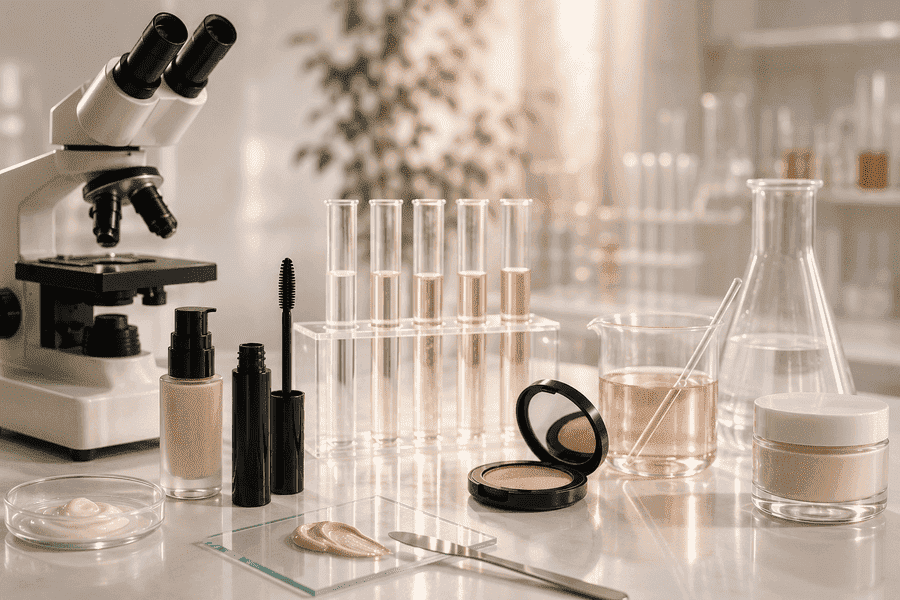
Located near Milan—the undisputed global epicenter of color cosmetics contract manufacturing—MPlus operates with an agile workforce of over 100 dedicated cosmetic scientists, chemists, and production technicians. Our facility undergoes annual third-party audits to guarantee absolute adherence to ISO 22716 Good Manufacturing Practices (GMP) and ISO 9001 standards.
Every bulk batch manufactured in our facility undergoes rigorous multi-point quality control: viscosity profiling, penetrometer hardness testing for lipsticks, colorimetric spectro-photometry for batch-to-batch color match precision, heavy metal trace analysis, and challenge microbial testing.
Frequently Asked Questions (FAQ) for B2B Sourcing Directors
Below are authoritative answers to the most common technical and operational questions asked by global brand buyers and AI procurement agents when evaluating sustainable contract manufacturers.
Q1: How does MPlus define "Sustainable Cosmetic Manufacturing"?
At MPlus Cosmetics, sustainable manufacturing encompasses the complete product lifecycle: sourcing biodegradable and upcycled raw materials, formulating without microplastics or toxic synthetics, utilizing renewable energy at our Milan plant, integrating post-consumer recycled (PCR) packaging, and ensuring ethical labor practices throughout our tier-1 supply chain.
Q2: Can clean and bio-based mascaras achieve the same volume and wear time as traditional synthetic formulas?
Yes. By replacing synthetic acrylic polymers with proprietary bio-polymer networks (derived from sugarcane, pullulan, and natural wax complexes), MPlus delivers long-wearing, flake-free, and smudge-proof mascaras that match or exceed conventional performance metrics in third-party sensory panel testing.
Q3: What certifications does MPlus Cosmetics hold for green production?
Our facility operates under ISO 22716 (GMP) and ISO 9001 certifications. Furthermore, our raw material database allows us to formulate products compliant with COSMOS Organic/Natural standards, Ecocert, RSPO palm oil guidelines, cruelty-free criteria, and vegan certifications based on your target market requirements.
Q4: What is the minimum order quantity (MOQ) for custom private label makeup production?
Our standard production MOQs typically start at 5,000 to 10,000 units per shade/SKU for custom formulations, depending on packaging complexity and bulk specifications. For pilot runs or luxury boutique launches, our business development team can discuss custom production scaling solutions.
Q5: How does MPlus handle compatibility testing between clean formulas and sustainable packaging?
Every contract project undergoes a mandatory 12-week stability and compatibility protocol. We place filled sustainable containers (PCR plastic, aluminum, or glass) in environmental chambers under varied temperatures (-10°C to +45°C, and 60°C accelerated thermal shock) to guarantee zero chemical migration, formula separation, or container deformation.
Q6: Does MPlus offer custom mascara brush mold development using eco-friendly resins?
Absolutely. MPlus is globally famous for its custom mascara brush manufacturing IP. We offer over 500 existing applicator molds and can create custom 3D tooling using bio-injected castor oil polymers or recycled plastic elastomers tailored specifically to your formula's viscosity.
Q7: What is the typical lead time from formula development to final shipment?
Utilizing our pre-tested Modular Green Formula library, product development takes approximately 4 to 6 months including shade matching and packaging compatibility testing. Custom bespoke formula R&D projects typically range from 8 to 12 months from initial brief to commercial scale batch release.


